
Blog
7 Powerful Ways to Detect Counterfeit Dollars in 2026 Before You Lose Money


Detect Counterfeit Dollars in 2026: The Complete Expert Protection Guide
To detect counterfeit dollars in 2026, you need to understand modern security features, evolving fraud tactics, and official verification standards used by banks and businesses. Counterfeit currency remains a serious global issue, and accepting a fake bill can lead to direct financial loss.
According to the U.S. Secret Service counterfeit currency division, protecting U.S. currency integrity is a federal priority due to the worldwide circulation of American banknotes. As counterfeit technology improves, detection methods must also evolve.
This guide explains exactly how to detect counterfeit dollars in 2026 using proven, reliable techniques.
Table of Contents
- Why Counterfeit Dollars Are Still a Risk in 2026
- 7 Powerful Ways to Detect Counterfeit Dollars in 2026
- Understanding Modern U.S. Security Features
- Professional Tools Businesses Use to Verify Bills
- Common Counterfeit Errors to Watch For
- What To Do If You Receive Fake Currency
- Final Expert Recommendations
Why Counterfeit Dollars Are Still a Risk in 2026
Despite advancements in banknote technology, counterfeiters continue attempting to replicate U.S. currency. The widespread international use of the dollar makes it a frequent target.
The Federal Reserve currency education resources explain that U.S. currency includes layered security features designed specifically to prevent replication.
Many businesses still rely on only one verification method, which increases risk. To properly detect counterfeit dollars in 2026, you must combine physical inspection with technology-based verification.
7 Powerful Ways to Detect Counterfeit Dollars in 2026
1. Inspect the Embedded Security Thread
Every genuine U.S. bill contains a vertical security thread embedded in the paper.
The official U.S. Currency Education Program details how each denomination has a uniquely positioned thread that glows under ultraviolet light. If the thread appears printed on the surface rather than embedded, the bill is counterfeit.
2. Check the Color-Shifting Ink
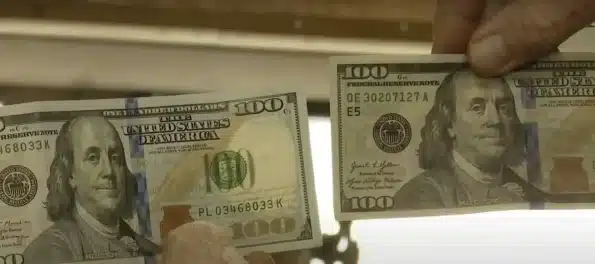
Tilt the bill under the light. On authentic $100 notes, the numeral in the lower right corner shifts from copper to green.
Color-shifting ink is extremely difficult to duplicate accurately and remains one of the most reliable ways to detect counterfeit dollars in 2026.
3. Feel the Paper Texture
Genuine U.S. currency is printed on a cotton-linen blend, not standard paper.
The Bureau of Engraving and Printing explains that the paper composition is unique and cannot be legally replicated. Authentic bills feel slightly rough with raised printing, while counterfeit notes often feel smooth or waxy.
4. Look for Microprinting
Microprinting appears around portraits and borders. Use a magnifying glass to inspect small text near security features. Fake bills often blur this text because consumer-grade printers cannot reproduce fine details.
5. Verify the 3D Security Ribbon on $100 Bills
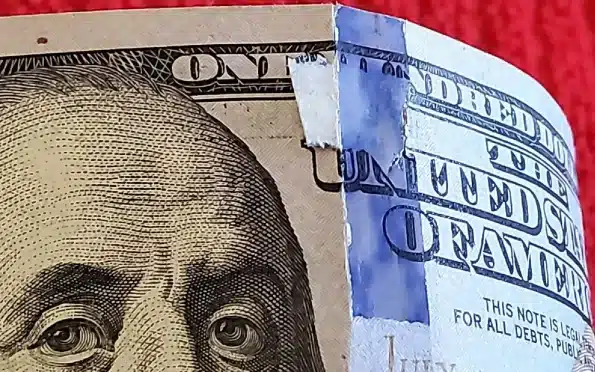
Modern $100 bills include a blue 3D security ribbon woven into the paper. When tilted, bells and numbers move independently. This feature is impossible to replicate using standard printing methods.
6. Examine the Watermark Carefully
Hold the bill up to light. A genuine watermark should match the portrait printed on the note and be visible from both sides. If the watermark looks flat or misaligned, the bill is suspicious.
7. Use Ultraviolet Light Verification
Under UV light, the embedded security thread glows a specific color depending on denomination. Professional retailers use UV scanners because visual inspection alone is not always sufficient. Combining UV inspection with tactile verification increases detection accuracy.
- Official demonstration from [U.S. Currency Education Program] showing security features
Understanding Modern U.S. Security Features
To consistently detect counterfeit dollars in 2026, it is important to understand how genuine currency is manufactured. Modern banknotes include:
- Embedded fibers
- Raised intaglio printing
- Color-shifting ink
- Watermarks
- Security threads
- 3D motion ribbons
These layered features work together. According to the U.S. Department of the Treasury, currency security improvements are continuously updated to stay ahead of counterfeiting techniques. Counterfeiters may replicate one feature, but rarely all features correctly.
Professional Tools Businesses Use
Banks and currency exchanges use advanced tools such as:
- Automated bill validators
- Magnetic ink detectors
- UV light scanners
- High-resolution verification systems
While counterfeit detection pens are common, they are not foolproof. Criminals sometimes bleach lower-denomination genuine notes and reprint higher values on authentic paper. Layered verification is essential to detect counterfeit dollars in 2026 effectively.
Common Counterfeit Errors to Watch For
When inspecting a bill, check for:
- Blurry portrait edges
- Incorrect serial number spacing
- Misaligned borders
- Missing embedded thread
- Ink that does not shift color
- Flat watermark appearance
Small inconsistencies are often the biggest red flags.
What To Do If You Receive a Counterfeit Bill
If you suspect a bill is counterfeit:
- Do not return it to the individual.
- Avoid confrontation.
- Contact local authorities.
- Follow reporting guidance provided by the U.S. Secret Service.
Document the time, transaction amount, and physical description of the person involved.
Final Expert Recommendations
To reliably detect counterfeit dollars in 2026:
- Always verify at least three security features
- Use UV light when possible
- Train staff regularly
- Compare suspicious bills to a confirmed genuine note
- Stay updated through official federal resources
Counterfeit detection is not about guessing. Consistent verification and understanding authentic currency design dramatically reduce risk and protect your business.